
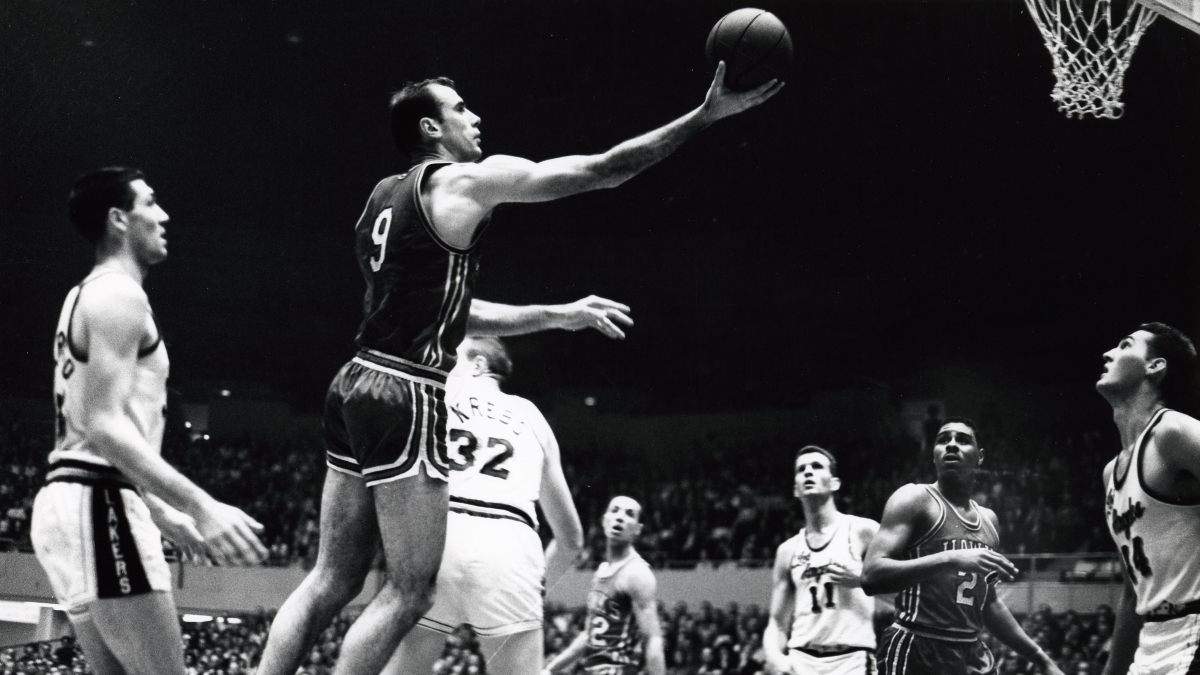
The NBA has lost one of its earliest legends. Bob Pettit, a historic figure for the St. Louis Hawks and LSU, has died at the age of 93, as announced by his former university, which did not disclose the cause of death.
Pettit, who played in the NBA from 1954 to 1965, was one of the pioneers of the league, setting several of the early milestones that helped shape the history of the sport. He was, for example, the first player to win the MVP since its inception in the 1955-56 season, the first to score 20,000 career points, and the first to receive four NBA All-Star Game MVP awards, a record he still shares today with Kobe Bryant.
The NBA family mourns the passing of Naismith Hall of Famer Bob Pettit, a two-time NBA MVP and a member of all four NBA Anniversary Teams. He raised the bar for excellence as the league’s first MVP, first 20,000-point scorer and first four-time All-Star Game MVP. His iconic… pic.twitter.com/y9CIxazjP5
— NBA (@NBA) September 24, 2026
Bob was also Rookie of the Year in his first NBA season, won a second MVP in 1959, and was chosen as an All-Star and All-NBA in his 11 seasons, being named to the All-Star and All-NBA teams in every season except the final stretch of his career when he did not make the First Team. Finally, he led the Hawks to the championship in 1958, a title he came close to winning on three other occasions, but was denied in the Finals by Bill Russell’s Celtics, two of them in Game 7.
Yet his impact goes beyond the accolades. In an era when professional basketball was still taking its first steps, he helped define the power forward position at a time when it was not yet a recognized role. As one of the first tall players who did not simply play with his back to the basket, Pettit’s versatility enriched the game, expanding the tools and options available and contributing to the evolution of the sport into what we know today. He remains one of the most influential figures in the history of basketball.
Thus, Pettit ended his career in 1965 with 20,880 points and 12,849 rebounds to his name, and in 1970 he was inducted into the Hall of Fame in recognition of his career, which will be forever preserved in the annals of basketball.